
Over the past fifty years, African women have made remarkable headway in the area of theological education. In this blog I present a variety of resources – most of which are freely accessible – including books, chapters, articles, videos and websites, that together provide a helpful overview of this important topic.
Mercy Amba Oduyoye tells how the story began (Oduyoye 1990). In 1970, Brigalia Bam, Mercy Amba Oduyoye, and three other African women theologians attended a consultation on the ordination of women in Cartigny, Geneva, Switzerland. They agreed to build a network of “sisters” to support one another and increase their impact on the church and society. Ten years later, around thirty women gathered for a consultation on women theologians in Ibadan, Nigeria. They planned to establish an association of women theologians and fight against the discrimination of women in theological institutions. In 1989, sixty-nine women attended the launch of the Circle in Legon, Accra, Ghana. Since that moment, the Circle has led the way in supporting women in theological education and addressing the challenges that they face. Isabel Apawo Phiri offers a valuable reflection on some of these challenges (Phiri 2009). Dietrich Werner and Isabel Apawo Phiri provide a comprehensive survey of theological education in Africa that contains a number of important chapters on women (Werner and Phiri 2013). Linda Naicker gives an up-to-date account of the transformative impact of the Circle on women in theological education (Naicker 2024).
Nevertheless, there is still much work to be done. Mary Wanjiku Kihuha discusses the resistance that emerging female theologians can face in their work (Kihuha 2023). Flore Badilla, Angélique Ngale and Agnes Ibanda give francophone perspectives on the need for more women in theological education (Badilla, Ngale and Ibanda 2025). Verena Schafroth uses a mixed methods approach to describe the current challenges and make recommendations for change (Schafroth 2024). Over the past few years, in addition to the Circle, new initiatives like “ACTEA for Women” and Watawa Wa Taa have been started to try to address these challenges. Finally, Felicia Chinyere Priest, Verena Schafroth and Marilyn Naidoo take a collaborative approach to empowering women in theological education (Priest, Schafroth and Naidoo 2025).
“ACTEA for women.” The Association for Christian Theological Education in Africa. Accessed 24 October 2025. https://acteaweb.org/actea-for-women.
An Evangelical initiative that aims to support both established and emerging female theologians in the areas of training, networking and collaboration, publishing, strategic planning, and mentoring.
Badilla, Flore, Angélique Ngale, and Agnes Ibanda. "Women in Theological Education." Interview video, 04:04. Recorded by Mesa Global. Posted 28 August, 2025. https://www.youtube.com/watch?v=JnM_XGsbwH8.
In this interview three established female theologians from Francophone Africa discuss the importance of women in theological education, emphasizing their contributions to the life and mission of the church.
Kihuha, Mary Wanjiku. "The Legacy of Women in Theological Education in Kenya." Video presentation, 01:12:27. Recorded by the Oxford Centre for Mission Studies. Posted 30 October, 2023. https://www.youtube.com/watch?v=CrXqMD7a11E.
Mary Wanjiku Kihuha, a Kenyan Pentecostal theologian, discusses her experiences as a woman teaching theology at Pan-Africa Christian University, a Pentecostal institution in Nairobi. She explains the challenges that she faced as an emerging theologian and how she draws on the resources and networks developed by the Circle to counter them.
Naicker, Linda. “The Role of the Circle of Concerned African Women Theologians in Engendering Theological Higher Education in Africa.” Studia Historiae Ecclesiasticae 50, no. 2 (2024): 12 pages. https://doi.org/10.25159/2412-4265/16618.
A valuable overview of Circle’s impact on theological education by a South African theologian. Linda Naicker highlights the Circle’s contributions to African Women’s theology, mentorship, female student enrolment, female faculty employment, curriculum transformation and advocacy. In particular, she emphasizes the need for a data-driven approach to inform the Circle’s strategic planning.
Oduyoye, Mercy Amba. “The Search for a Two-Winged Theology: Women's Participation in the Development of Theology in Africa —The Inaugural Address.” In Talitha Qumi! Proceedings of the Convocation of African Woman Theologians, Trinity College, Legon-Accra September 24-October 2, 1989, edited by Mercy Amba Oduyoye and Musimbi R. A. Kanyoro. SWL Press, 1990.
Mercy Amba Oduyoye, a Ghanaian Methodist theologian, ecumenical leader and founder of the Circle, describes the pioneering consultation held at Ibadan in 1980, which reflected on the role and contribution of African women theologians in relation to theological education and ministry. She discusses the challenges facing women and the strategic steps they have taken to overcome them, including the establishment of the Circle and the Institute of Women in Religion and Culture (now called the Talitha Qumi Centre).
Phiri, Isabel Apawo. “Major Challenges for African Women Theologians in Theological Education (1989–2008).” International Review of Mission 98, no. 1 (2009): 105–19. https://doi.org/10.1111/j.1758-6631.2009.00009.x.
An authoritative article by a Malawian Presbyterian theologian, ecumenical leader and the general coordinator of the Circle from 2002-2007. Isabel Apawo Phiri introduces the Circle and reflects on four major challenges facing female theologians: redefining their identity, getting opportunities to study and teach, including women’s theology in the theological curriculum and collaborating with male theologians. Freely accessible from the World Council of Churches.
Priest, Felicia Chinyere, Verena Schafroth, and Marilyn Naidoo, eds. Empowering Voices: African Women in Theological Education. ICETE Series. Carlisle: Langham Global Library, 2025. https://langhamliterature.org/books/empowering-voices.
Empowering Voices is a collaborative work, including chapters by both female and male contributors, that assesses the situation of women in theological education, highlighting their distinctive role and suggesting ways to support their endeavours. Noteworthy chapters include Marilyn Naidoo on dealing with epistemic injustice against women, Verena Schafroth on the importance of gender equity for excellence in theological education and Sibonokuhle Ncube and Martine Audéoud on the challenges and opportunities for women in academic theological publishing.
Schafroth, Verena. “Women in Male Spaces: Female Faculty in Theological Education in Africa.” InSights Journal 10, no. 1 (2024): 1–16. https://insightsjournal.org/male-spaces-female-faculty-in-theological-education-in-africa.
A valuable contribution by a German theological educator with many years of experience in sub-Saharan Africa. Verena Schafroth draws on both qualitative and quantitative research to describe the challenges facing female faculty and make recommendations about how to address them. She emphasises regulation and affirmative action, family-friendly policies, network and mentoring, research, publication, and promotions, and professional development.
Watawa Wa Taa. Accessed October 24, 2025. https://watawa.org.
Watawa wa Taa, which roughly translates as “Consecrated Women of Light,” is a Catholic initiative that aims to support African Catholic sisters, including those in theological education, by celebrating their witness and gathering their wisdom. Watawa especially focuses on network building, advocacy and mentoring.
Werner, Dietrich, and Isabel Apawo Phiri, eds. Handbook of Theological Education in Africa. Regnum Studies in Global Christianity. Oxford: Regnum, 2013. http://www.ocms.ac.uk/regnum/downloads/Handbook_of_Theological_Education_in_Africa-Watermarked.pdf.
A landmark publication on theological education in Africa that includes many contributions by African women theologians and a number specifically dealing with women in theological education. Chika Eucharia Eze offers a Roman Catholic perspective, Priscille Djomhoue describes the situation in Francophone Africa, Esther Mombo discusses mentoring, Mercy Amba Oduyoye focuses on popular theology and Isabel Apawo Phiri examines the role of the Circle.
Samuel K. Bussey is a doctoral student in Intercultural Theology at the Protestant Theological University in Utrecht, the Netherlands.
(Over the past four years, Heleen Zorgdrager has provided administrative oversight for African Theology Worldwide. In celebration of Heleen’s involvement in the project, a special bibliography and blog were commissioned on “Women in Theological Education,” a cause that Heleen has championed throughout her academic career. The bibliography can be found here.)
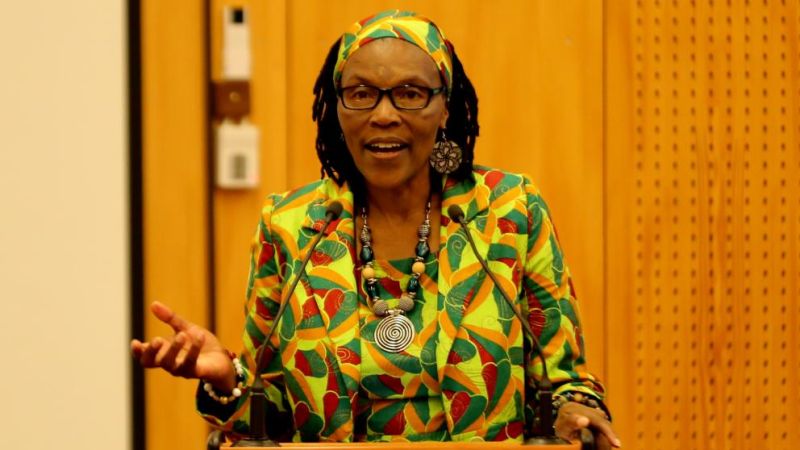
Photo: Esther Mombo