
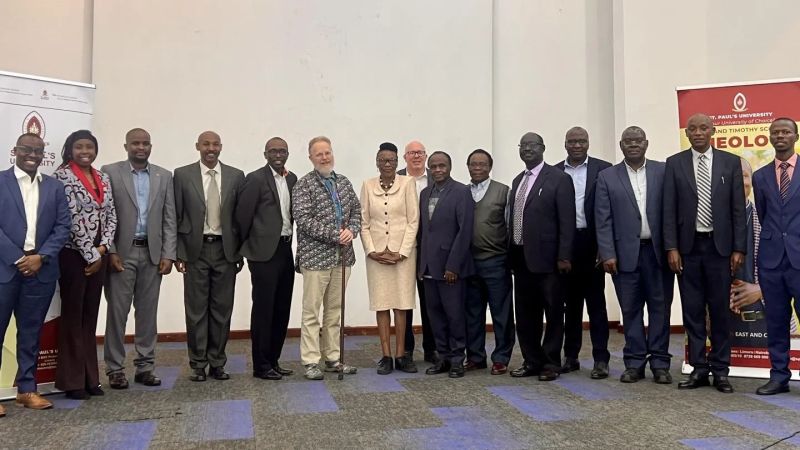
On March 31 and April 1, 2026, St. Paul’s University partnered with the Project on Religion and Society in Africa to host the AI and Theological Education Workshop in Nairobi. The landmark consultation convened senior leadership and faculty from several prominent theological institutions. Together, these academic leaders gathered to collaboratively map the future of artificial intelligence within African theological education.
The two-day event opened with a compelling charge from Professor Esther Mombo, Acting Vice Chancellor of St. Paul’s University, and recipient of an honorary Doctorate from the Yale Divinity School. Describing artificial intelligence as operating at the “intersection of faith and knowledge and technological transformation,” she challenged attendees to remain vigilant regarding pedagogy, access, and spiritual formation.
Building on this, Michael Glerup, Program Director of the Project on Religion and Society in Africa, highlighted a critical gap: the current under-representation of African traditions and religious nuances in major AI models. He urged the academic community to actively shape the technology to make it a more fruitful tool for regional endeavors. Similarly, Julius Kithinji, Dean of the Theological School at St. Paul's, reminded participants to consider not just how AI contributes to theology, but how theology must contribute to and guide AI.
Facilitated by Kevin Muriithi, Director of Research at St. Paul’s, and Kyama Mugambi, Assistant Professor of World Christianity at Yale Divinity School and Faculty Lead for the Project on Religion and Society, the workshop sessions revealed a broad spectrum of institutional readiness. While some campuses have already invested in digital infrastructure and structured AI awareness programs, others expressed hesitation. Joshua Barron, representing ACTEA, noted that anecdotal evidence across nearly 200 institutions suggests a widespread need for technological preparedness.
To address these gaps, participants engaged in robust discussions on leveraging AI to elevate research, enrich student learning, and improve administrative efficiency. A recurring theme was the urgent need to ground these technological advancements in solid ethical foundations. Wanjiku Kihuha from PAC University captured the room’s consensus: “Without a theological framework, we cannot properly inform policy, training, and implementation, or even the ethics of AI use.” Martin Munyao of Daystar University echoed this, emphasizing the need for clear institutional guidelines for AI use in daily assignments and learning activities.
Looking ahead, the workshop marked the beginning of an ongoing, collaborative journey. Participants committed to cultivating institutional virtues of flexibility, humility, and strategic curiosity. Recognizing that students are already engaging with these tools, attendees proposed joint initiatives to secure technology grants, strengthen campus infrastructures, and proactively embed authentic African scholarship within global AI frameworks.
By thinking together and supporting one another, St. Paul’s University and its academic partners are ensuring that tertiary theological education remains at the forefront of ethical innovation, ready to guide the next generation of leaders with integrity, vision, and a distinctively African voice.
Kyama Mugambi (PhD) is Assistant Professor of World Christianity at Yale Divinity School. His research explores historical, ecclesial, social, cultural, theological, and epistemological themes in African urban Christianity. His most recent book, Christians in the City of Nairobi: An African City and the Future of World Christianity (Bloomsbury Academic, 2025), co-authored with Prof. Mark Shaw, examines how the diverse Christian traditions in Kenya’s capital engage with and respond to the secularizing forces of the modern city. His earlier work, A Spirit of Revitalization: Urban Pentecostalism in Kenya (Baylor University Press, 2020), traces the development of Pentecostal Christianity in Kenya from 1920 to 2020. The book has been recognized as a significant contribution to mission studies, world Christianity, and intercultural theology. His current research focuses on oral liturgies within charismatic Christian movements across the African continent. Dr. Mugambi is faculty lead for the Yale MacMillan Center’s Project on Religion and Society in Africa, which promotes critical inquiry into the relationship between religion and societal well-being, and investigates how religious frameworks can foster human and communal flourishing.
Photo Credit: Kyama Mugambi
(This blog is reposted with permission from the MacMillan Center for International and Area Studies at Yale.)